

A capable telehealth app development company should be able to translate a care pathway into a secure digital workflow rather than only build a video-call interface. The companies below work across telehealth, healthcare software, AI-enabled tools, remote monitoring, and clinical integrations, making them relevant options for hospitals, multi-speciality clinics, and independent practices.
Why AI matters in telehealth
AI in telehealth does not replace clinical judgement. Its practical role is to reduce repetitive work, organise information, highlight patterns, and make virtual care easier to navigate for both patients and care teams.
Common use cases include appointment triage, symptom-intake flows, transcription support, patient-risk indicators, remote-monitoring dashboards, follow-up reminders, and analytics for operational planning. The value depends heavily on how well the technology connects with existing systems such as EHR/EMR platforms, scheduling tools, pharmacy systems, and billing workflows.
When evaluating a white label telemedicine platform , hospitals and clinics should look beyond branding options. Compliance readiness, data governance, role-based access, clinical workflow flexibility, integration capability, and scalability matter just as much as the front-end design.
Top 9 AI Telehealth App Development Companies
1. Developer Bazaar
Developer Bazaar works on custom digital products for healthcare-oriented businesses, with a focus on mobile and web application development. Its telehealth work can be approached as a workflow-first build, where consultation, scheduling, records, and follow-up processes are mapped before development begins.
- Builds patient-facing and provider-facing applications with modular features, allowing clinics to begin with core consultation flows and expand into monitoring or care-management modules
- Can support AI-assisted features such as smart intake forms, appointment-routing logic, automated reminders, and structured patient-history capture.
- Useful for clinics that want a tailored experience rather than adapting their operations to a fixed off-the-shelf product.
- Its development approach can accommodate both a standalone virtual-care app and a broader healthcare platform connected to internal systems.
For a clinic planning to develop telemedicine app for doctors , this type of custom approach can help align the product with the doctor’s consultation style, speciality requirements, and patient-communication preferences.
2. QSS Technosoft
QSS Technosoft focuses on intelligent telehealth applications that use AI and machine learning for real-time diagnostic support, symptom checkers, and personalised treatment pathways. Its work is particularly relevant for providers looking to introduce decision-support layers into virtual care.
- Develops AI-led telehealth mobile applications with capabilities such as symptom assessment and personalised care-path recommendations.
- Places emphasis on real-time data use, which can support remote monitoring and timely clinical follow-up.
- Suitable for healthcare organisations that want to combine virtual consultations with intelligent patient-engagement features.
- Its experience spans enterprise-grade digital transformation, making it relevant for larger clinics and hospital networks.
The company’s positioning around AI and machine learning makes it a practical option for teams that want telehealth to do more than host video appointments.
3. Prioxis
Prioxis develops custom telehealth software for hospitals, clinics, healthcare providers, and digital-health companies. Its work includes compliance-focused telemedicine platforms, virtual consultation systems, and AI integration.
- Builds HIPAA- and GDPR-conscious telehealth software for healthcare providers and multi-location networks.
- Supports online appointment management and remote consultations for clinics as well as independent practitioners.
- Offers AI integration as part of its telemedicine development capability.
- Works with hospitals and healthcare networks that need to extend services through virtual-care platforms.
For organisations operating across several locations, Prioxis may be worth considering when the priority is a consistent virtual-care experience across departments, branches, or affiliated clinics.
4. Clarion Tech
Clarion Tech works across healthcare software, telemedicine, EHR/EMR systems, remote patient monitoring, data analysis, and imaging platforms. Its AI/ML focus includes predictive analytics, automated diagnosis support, and personalised care plans.
- Develops telemedicine applications and web portals for medical practitioners, hospitals, emerging clinics, and healthcare networks.
- Applies AI and machine learning to predictive analytics, workflow automation, and personalised care planning.
- Has experience with EHR/EMR, health-information exchange, remote monitoring, and medical-imaging platforms.
- Supports mobile, web, cloud-based, on-premise, and hybrid deployment models.
This breadth makes Clarion Tech relevant for providers whose telehealth plans depend on connecting virtual consultations with wider clinical infrastructure.
5. Cleveroad
Cleveroad builds bespoke telehealth and telemedicine solutions, including SaaS-based platforms, for medical and remote-care organisations. Its approach combines custom workflow design with intelligent solutions intended to optimise healthcare services.
- Creates custom telemedicine platforms tailored to a provider’s existing business processes.
- Works with SaaS-based telehealth models, which can suit organisations planning multi-site or multi-provider rollouts.
- Focuses on intelligent solutions that streamline healthcare services and operational workflows.
- Builds for both physical and mental well-being use cases, giving it relevance beyond general consultation apps.
Cleveroad is particularly relevant for healthcare organisations that view telehealth as part of a broader service-design and workflow-optimisation initiative.
6. Topflight Apps
Topflight Apps works with hospitals, clinics, health-tech innovators, and startups on HIPAA-conscious mobile and web applications. Its portfolio includes telemedicine platforms, patient portals, EHR integration, remote patient monitoring, and AI/ML-based healthcare applications.
- Develops telemedicine platforms, patient portals, and remote patient monitoring applications.
- Has experience with EHR/EMR integration, wearable health technology, mental-health apps, and medical billing software.
- Applies AI where it can improve documentation, surface insights, and optimise operational processes.
- Serves hospitals, health systems, clinics, private practices, insurers, and medical-device companies.
For a hospital evaluating a patient-centred virtual-care experience, Topflight Apps may be relevant where mobile usability, patient engagement, and connected devices are central requirements.
7. Overcode
Overcode builds HIPAA-conscious web and mobile platforms for hospitals, private clinics, and digital-health startups. Its work is often associated with fast, compliant builds and a strong focus on clinical user experience.
- Develops HIPAA-conscious telemedicine platforms for hospitals, private clinics, and digital-health startups. ]
- Works with modern web technologies including React and Next.js, alongside AWS-based infrastructure.
- Focuses on clinical UX, which can reduce friction for both patients and care teams during virtual consultations.
- Is positioned for organisations that need compliant telehealth builds delivered with a clear, practical development process.
This makes Overcode a potential fit for clinics that want a clean, usable virtual-care product without overcomplicating the initial rollout.
8. Glorium Technologies
Glorium Technologies works on specialty telehealth, AI diagnostics, workflow automation, and white-label platforms. Its experience is especially relevant for healthcare providers with defined clinical specialities or complex care pathways.
- Builds specialty telehealth solutions rather than treating every virtual-care product as a generic consultation app.
- Works with AI diagnostics and workflow automation, which can support triage, documentation, and care coordination.
- Offers white-label platform development for organisations that need a branded telehealth experience.
- Is suited to complex specialty telehealth programmes that require customised clinical workflows.
For a speciality clinic, such as dermatology, mental health, physiotherapy, or chronic-care management, this focus on specialty workflows can be more meaningful than a standard video-consultation feature set.
9. Excellent Webworld
Excellent Webworld develops custom telemedicine applications for healthcare providers, with attention to AI-powered patient care, security, cloud infrastructure, and EHR/EMR integration. Its work is oriented around accessible virtual care and personalised patient journeys.
- Builds AI-driven telemedicine platforms with personalised care plans and 24/7 accessibility across devices.
- Includes EHR/EMR integration, telemedicine security, and cloud infrastructure in its development approach.
- Focuses on patient-first design, aiming to improve communication and appointment retention.
- Develops custom applications for healthcare providers seeking faster and more accessible virtual care.
Excellent Webworld may be a suitable option for providers that want to build a patient-friendly telehealth experience while retaining room for clinical and operational integrations.
How to choose the right partner
The best choice depends less on a company’s size and more on the fit between its capabilities and the care model being digitised. A hospital launching a multi-department virtual-care programme will have different needs from a single-speciality clinic testing remote follow-ups.
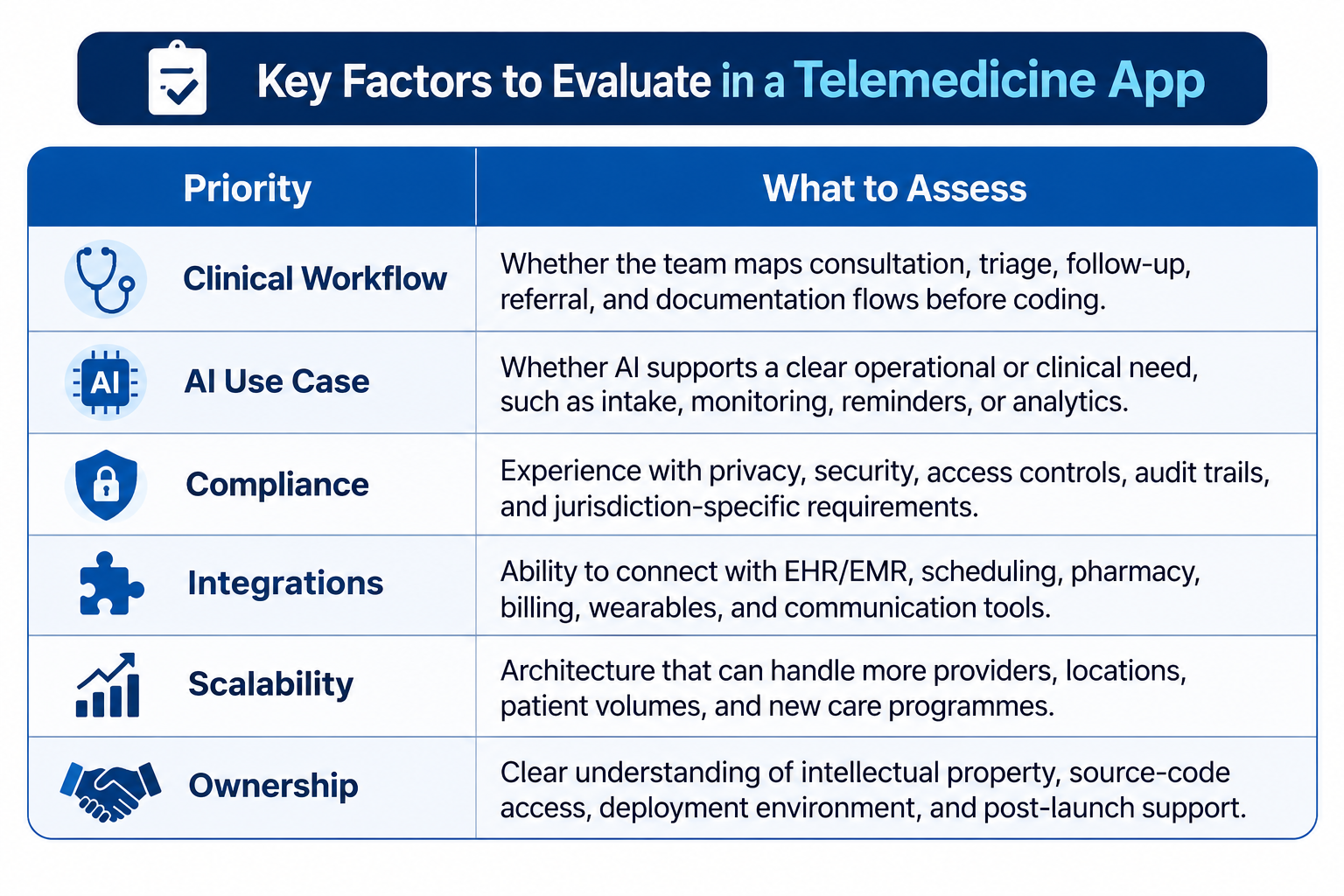
Before signing with any telehealth app development company, ask for a workflow map, a data-flow diagram, integration assumptions, security approach, and a phased rollout plan. These documents reveal whether the partner understands healthcare delivery—not just app development.
Questions to ask before starting
- Which AI features are essential at launch, and which can wait until the platform has real usage data?
- How will patient consent, data access, retention, and deletion be handled?
- Which existing systems must the telehealth platform integrate with on day one?
- What happens when a virtual consultation requires escalation to in-person care or emergency support?
- How will clinicians review, override, or document any AI-assisted recommendation?
- Can the platform be deployed in the provider’s preferred cloud or on-premise environment?
- What role-based permissions will be needed for doctors, nurses, administrators, patients, and support staff?
A thoughtful telehealth programme begins with a clearly defined care journey. Whether a hospital needs a custom platform or wants to hire telemedicine app developers for an internal product team, the strongest results usually come from pairing clinical expertise with disciplined engineering, privacy safeguards, and measurable patient outcomes.
Frequently Asked Questions
Q1. What is an AI telehealth app?
An AI telehealth app is a digital platform that supports virtual care through features such as video consultations, appointment scheduling, patient intake, remote monitoring, secure messaging, and AI-assisted workflows. AI may help organise patient information, route requests, generate reminders, transcribe notes, or identify patterns in health data. It supports clinical teams; it does not replace a doctor’s judgement.
Q2. How can hospitals use AI in telehealth?
Hospitals can use AI to simplify appointment triage, automate follow-up communication, support remote patient monitoring, summarise consultation notes, and give administrators better visibility into demand and operational gaps. For example, an AI-enabled intake flow can collect preliminary symptoms and direct patients to the appropriate department, while clinicians retain full control over diagnosis and treatment decisions.
Q3. Is a white label telemedicine platform suitable for clinics?
A white label telemedicine platform can be suitable for clinics that want a branded virtual-care experience without building every component from scratch. It is important to review the platform’s customisation limits, data ownership, integration options, security controls, and ability to adapt to the clinic’s consultation workflow before choosing it.
Q4. What should clinics check before hiring telemedicine app developers?
Clinics should assess the team’s healthcare experience, understanding of privacy and security requirements, ability to integrate with EHR/EMR or scheduling systems, approach to usability, and post-launch support model. When you hire telemedicine app developers, request a workflow map, technical architecture outline, data-flow diagram, and a phased delivery plan rather than only a feature list.
Q5. Can AI telehealth apps work with existing hospital systems?
Yes, provided the platform is designed for interoperability. A telehealth system may need to connect with EHR/EMR software, appointment calendars, billing tools, pharmacy systems, laboratory services, wearables, and internal communication platforms. Early integration planning helps prevent duplicate data entry and fragmented patient records.
Q6. How long does telehealth app development take?
The timeline depends on scope. A basic consultation and scheduling app may take a few months, while a hospital-grade platform with AI features, EHR integration, remote monitoring, role-based access, and multi-location support can take longer. A phased rollout is often more practical because it allows clinical teams to test core workflows before advanced features are added.
Q7. What is the biggest risk in AI telehealth?
The biggest risk is treating AI as a decision-maker rather than a support tool. Any AI-driven suggestion should be transparent, reviewable, and documented within the clinical workflow. Strong access controls, audit trails, consent management, and clear escalation paths for urgent cases are essential.